How Search Has Changed and What Hasn't .
Every few months, someone tells me SEO is dead. Sometimes it’s a headline. Sometimes it’s a client who has just read one. This year, AI is getting the blame.
Lately the question has gone a step further. More clients are asking whether they even need a website if people can get their answers straight from ChatGPT. It’s a fair question, and it deserves a proper answer, so I’ve written one on whether your business still needs a website in the age of AI.
I understand why people are asking. Search looks very different from how it did even two years ago. But when I look at how our clients’ customers actually find them, SEO isn’t disappearing. It’s being used in more places than ever.
How a Customer Finds a Business.
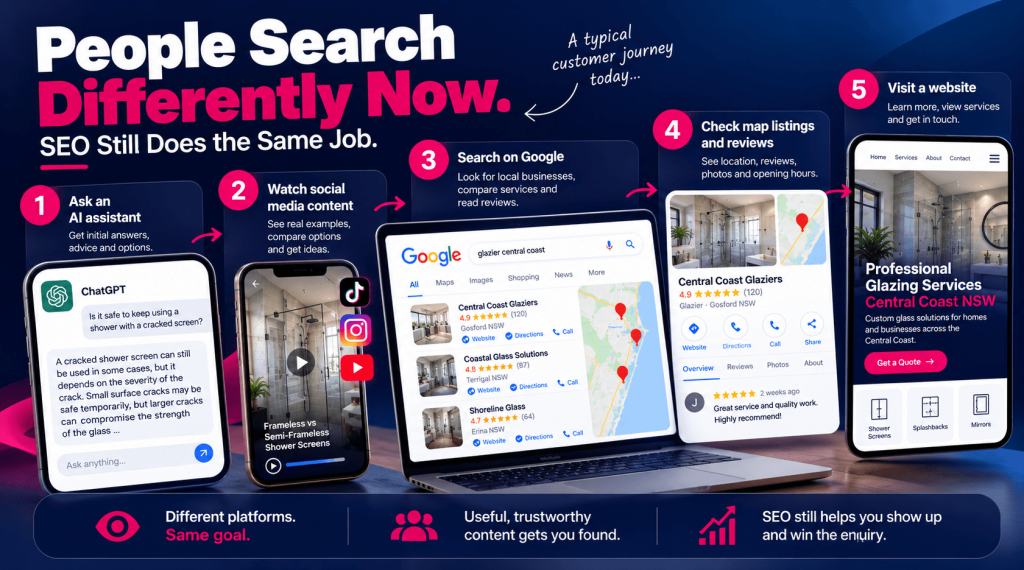
This is how a typical customer finds a local business now – take a glazier on the Central Coast.
Their shower screen cracks. They ask ChatGPT whether it’s safe to keep using the shower. They watch a couple of short videos comparing frameless and semi-frameless screens. Then they search Google for a glazier nearby, check the map listings, read the reviews on two businesses and visit one website before picking up the phone.
That’s one buying decision spread across AI, social media and search. Not long ago, almost all of it would have happened on a single Google results page.
What has changed is where people go looking and how they take information in. What SEO is for hasn’t changed at all: making a business visible wherever its customers are searching, with content good enough to earn their trust.
The Real Question - Is SEO Dead?
No. SEO isn’t dead in 2026 and I don’t believe it will be in 2027 either, but the places it has to work have multiplied: Google results, AI-generated answers and social platforms all draw on the same thing, which is useful, trustworthy content about your business.
People have been declaring SEO dead for well over a decade. Social media was going to replace search. Paid ads were going to make organic rankings pointless. Voice search was going to change everything. Now AI answers are supposed to finish the job.
Each time, what died was a shortcut. Tactics that worked because search engines were easy to fool stopped working once they weren’t. The businesses that kept publishing useful content for their customers are still being found.
Customers now find answers in three different places.
The biggest shift of the last few years isn’t a Google update. It’s that people have spread their searching across different platforms, and they use each one for a different job.
Search is still where decisions get made.
When someone is ready to compare businesses, check who services their area, read reviews and make contact, they still go to Google. Map listings, local results and branded searches (people typing in a business name to check it out) all sit here.
For a local service business, this is where most enquiries still start. It’s also where every other channel tends to lead back to.
AI answers are handling the early questions.
Google’s AI Overviews, ChatGPT, Gemini and Perplexity are now where a lot of people ask the early questions. How much should this cost? Which option is better? Is this normal, or do I need someone to look at it?
The AI reads a range of sources and summarises them. The businesses whose content gets pulled into those answers are being seen before the customer has visited a single website.
How often AI Overviews appear is contested, and anyone quoting one exact figure is oversimplifying. Depending on the tracker and industry, estimates through 2026 range from roughly one in five searches to around half. What the data broadly agrees on is the direction: they’re appearing on more searches than a year ago, and fewer people click through to websites when one is shown. These are often called zero-click searches, because the question gets answered without a visit to any site.
Social platforms have become search engines too.
TikTok, Instagram, YouTube and Reddit are now places people search, not just scroll. They look for ideas, honest reviews, how-to videos and before-and-after results. Adobe’s research on TikTok as a search engine found that a large share of people, and younger people especially, now use it to look things up.
Social media didn’t replace search, as people once predicted. It became another form of it. For trades and home services, it’s often where a customer first sees the quality of your work and gets a feel for who you are.
GEO and AEO are new names for the same work.
With AI search came a wave of new acronyms. Generative engine optimisation (GEO) and answer engine optimisation (AEO) both describe the same goal: getting your content used and cited in AI-generated answers.
They’re useful labels, and the work behind them matters. But look at what they involve in practice. Clear answers to real questions, accurate information about your business, content structured so it’s easy to understand, and a reputation that makes you a trustworthy source. That’s SEO. It always was.
A business owner doesn’t need three separate strategies for Google, AI and social. They need one strategy built on the same foundations, applied in more places.
The premise of SEO hasn't moved.
Strip away the platforms and SEO has always done one thing: create visibility with high-quality content.
That still means understanding what people are looking for, why they’re searching, what they need to know before they decide, and why they should trust one business over another. It still means a website that search engines can crawl and understand, that works properly on a phone and is easy to get around. And it still means building authority through relevant links, reviews, mentions and real expertise.
Google’s own guidance on creating helpful, reliable, people-first content comes back to the test it has used for years: was this made to help a person, or to attract a search engine?
AI systems deciding what to cite are applying much the same test. Google has said directly that its ranking systems reward original, high-quality content demonstrating experience, expertise, authoritativeness and trustworthiness (E-E-A-T), however it was produced.
The quality bar is higher.
AI can produce average content in seconds, so average content is everywhere. Good content now has to add what can’t be copied: first-hand experience, local detail and a real point of view.
Authority comes from more than backlinks.
Links still matter for Google rankings, but AI tools also weigh brand mentions, reviews, directory listings and discussion on sites like Reddit. Being talked about credibly across the web now counts alongside being linked to.
Structure and measurement have moved on.
Content needs to be easy for AI to pull a clean answer from, which is why direct answers and FAQs matter more than they used to. And traffic alone no longer tells the full story, because more searches now end without a click.
Each type of content now has a different job.
Something I’m seeing across our clients’ websites is that content has stopped doing one job. Different types of pages now serve different purposes, and the sites performing best are built with that in mind.
Landing pages and service pages do the ranking
These are the pages built to show up when someone searches for a service in their area, such as “glass repairs Gosford” or “shower screens Central Coast.” They’re focused, commercial and written to turn a visitor into an enquiry.
Blog content does two things at once.
It supports those service pages, building the depth and internal links that help them rank. It also picks up the long-tail searches: the longer, more detailed questions people type or ask out loud, like “can you replace just one panel of a frameless shower screen?” Those are exactly the questions people now put to AI tools, and a blog post that answers one properly is the kind of content AI answers draw from.
This is where the old and new ways of searching meet. The same blog post that strengthens a service page in Google can be the source an AI tool uses when a customer asks that question. And the knowledge in it can become a short video or a social post answering the same thing.
A generic article can’t do any of that. There’s nothing in it worth citing and nothing worth filming.
Planning comes before writing.
I don’t start by picking a keyword and asking AI to write 1,000 words about it. Before anything is written, I want to know the intent behind the search, who the reader is, where they are in the buying process, what questions the page has to answer, where it belongs on the site and what the reader should do next.
Someone asking “how much does glass replacement cost?” is at a completely different stage to someone searching “emergency glass repairs near me.” A service page, a cost guide, a location page and an educational article all do different jobs. Treating them as interchangeable is why so much content never performs.
Entities help machines understand who you are.
An entity is a clearly identifiable thing: a business, a person, a service, a place, a product. Google moved towards understanding entities rather than matching words back in 2012, when it launched the Knowledge Graph around the idea of “things, not strings.”
AI systems work the same way. They need to be able to tell who a business is, what it does, where it operates and what it has the authority to talk about. A glazier’s website that properly covers emergency glass replacement, shower screens, mirrors, safety glass and commercial glazing, along with the areas it services, gives them a far better picture than one that repeats “glass repairs” across every page.
Low-effort content is what's dying.
AI has made it easier than ever to produce content. It has also made it easier to produce a lot of generic, forgettable content.
Using AI as part of a considered process is different from typing a vague prompt and publishing whatever comes out. AI can help with research, planning, structure and drafting. It can’t know your customers, your commercial priorities, what makes you different or what you’ve learned from years on the job. Generic prompts create generic content, and when hundreds of businesses publish the same article, there’s no reason for Google, an AI tool or a customer to prefer yours.
A few older habits are losing value for the same reason:
- Keyword stuffing. Repeating an exact phrase makes a page harder to read, not more relevant.
- Thin location pages. Swapping a suburb name across identical pages adds nothing for the reader.
- Writing to a word count. A page should be as long as the answer needs, and no longer.
- Chasing backlink numbers. One relevant, credible link is worth more than hundreds of irrelevant ones.
- Treating schema as a shortcut. Google’s structured data guidelines require markup to match what’s visible on the page. Marking up things that aren’t there can count against you.
- Measuring rankings alone. Enquiries, bookings and sales tell you far more about whether SEO is working.
How to tell if you're being found.
When fewer searches end in a click, traffic on its own stops being a reliable measure. A business can be seen more often and still get fewer visits.
Google Search Console is the first place to look. If impressions (how often your pages appear in results) are holding steady or rising while clicks drop, people are still seeing you. More of them are getting their answer before they reach your site. Branded searches, where people type in your business name, are another good sign that visibility elsewhere is turning into interest.
For AI visibility, the simplest test is also the most useful. Ask ChatGPT, Gemini or Perplexity the questions your customers ask, and see which businesses come up. If your competitors are being mentioned and you’re not, that tells you where the content gaps are.
What this means for a local business.
You don’t need to be on every platform tomorrow. The businesses being found in 2026 tend to get a handful of things right, and most of them start with the website.
Your website is the source everything else points back to, and AI tools draw from it. If it’s thin, outdated or vague about what you do and where you work, every other channel is built on a weak foundation. The fix usually starts with service pages that answer the real questions customers ask: prices, timeframes, options, what’s included and what can go wrong. Detailed answers are what get ranked, cited and shared.
Consistency matters more than most people expect. Your business name, services, service areas and contact details should match across your website, your Google Business Profile, directories and social accounts. When they don’t, it’s harder for search engines and AI systems to be confident about who you are.
It also pays to get more from what you already know. One solid guide can become a page, a handful of short videos and a few social posts. And before writing anything new, look at what’s already on the site. Updating a page that already has some authority often does more than publishing another blog post.
The channels will keep changing.
How people find businesses will keep shifting. There’ll be new platforms, new AI tools and new predictions about the end of SEO. The job underneath it won’t change: be the most useful, trustworthy source for your customers, then make that content easy for people and machines to find, understand and use.
If you’re not sure how your business shows up across Google and AI search, we offer a free website audit. We’ll look at how your site is structured, which pages are pulling their weight, where the content gaps are and what’s worth fixing first. It comes with a conversation, not a sales pitch, so you can ask questions and decide what makes sense for your business. Get in touch to book yours.
SEO isn’t dead. It just has more places to show up.
FAQs.
Is SEO still worth doing in 2026?
Yes. People are still searching and comparing before they buy, they’re just doing it across Google, AI tools and social platforms. SEO now covers traditional rankings and AI-generated answers at the same time, which takes more strategy than it used to, not less.
Is GEO replacing SEO?
No. Generative engine optimisation (GEO) is a newer name for optimising content so AI tools use and cite it. The work behind it (clear answers, accurate business information, well-structured content and a trustworthy reputation) is the same work that drives SEO. Most businesses are better served by one strategy that covers both.
How do I know if my business appears in AI answers?
Ask the AI tools directly. Put the questions your customers ask into ChatGPT, Gemini or Perplexity and see which businesses are mentioned. In Google Search Console, rising impressions with falling clicks can also show your content is being seen in search, even when fewer people click through.
Will AI search replace the need for a website?
No. AI tools need sources to draw from and cite. A website with clear, detailed, well-structured content is what gives them something worth citing. Without one, a business is much harder to find in both traditional and AI search. I’ve covered this in more detail in whether your business still needs a website in the age of AI.
Do people really use social media to search?
Yes, particularly younger audiences. Platforms like TikTok, Instagram and YouTube are now used to look up reviews, ideas and how-to information. For local service businesses, social content works best alongside a strong website, not instead of one.
What is entity-based SEO?
It’s optimising content around clearly identifiable things (a business, a service, a location, a product) and the relationships between them, rather than isolated keywords. Google has worked this way since launching the Knowledge Graph in 2012, and AI systems use the same relationships to decide what’s trustworthy.
Do I still need blog content if AI can answer questions?
Yes, and it may matter more than before. Blog content that answers detailed, long-tail questions is what AI tools draw from, and it strengthens the service pages that do the ranking. Generic content still struggles, though, because nothing separates it from everyone else’s version.
How long does it take to see results from SEO?
It depends on the competition in your industry and area, and how much work your website needs. Most businesses see meaningful movement over several months rather than weeks, and results tend to build as more pages are created and existing ones are improved.